
Calgary’s employment landscape posted robust gains through 2026, with the economic region adding 59,600 jobs and achieving 5.7% year-over-year employment growth. For business leaders and workforce planners, this expansion signals a tightening labour market that demands strategic hiring approaches and competitive retention programs.
The momentum extends beyond raw job creation. National construction unemployment dropped to 3.8% in September 2026, reaching its lowest point in two years, while Canada’s overall unemployment rate declined to 6.6% in May. These shifts reflect genuine capacity constraints rather than temporary fluctuations, meaning businesses competing for talent face sustained pressure to differentiate their employee value propositions.
Three dynamics now shape Calgary’s workforce environment: accelerated hiring timelines as companies race to secure qualified candidates, upward wage pressure in sectors experiencing the tightest labour supply, and growing investment in retention strategies that prioritize skill development and workplace flexibility. Organizations that treat talent acquisition as a strategic priority rather than a transactional function are gaining measurable advantage in critical roles.
The path forward requires both immediate tactical adjustments and longer-term workforce planning. Understanding which employment indicators signal durable trends versus short-term volatility will determine how effectively Calgary businesses translate economic growth into sustainable competitive advantage.
1. Calgary Region Posts 5.7% Employment Growth Year-Over-Year

The Calgary economic region delivered strong employment gains through 2026, with Calgary added 59,600 jobs over the year and employment climbing 5.7% year-over-year. This expansion marks a significant acceleration from the modest growth seen in 2024 and early 2025, signaling renewed confidence among employers and sustained momentum across multiple industries. The pace of job creation reflects both recovery from earlier economic headwinds and genuine expansion driven by regional investment and population growth.
While comprehensive sector-level breakdowns for 2026 remain forthcoming, the scale of job creation suggests broad-based contributions rather than growth concentrated in a single industry. Construction activity has been particularly robust, supported by major infrastructure projects and commercial development across the region. Professional services, technology sectors, and the media films economy have also demonstrated hiring momentum, diversifying the employment base beyond traditional energy-sector dominance. Energy itself continues to add positions, buoyed by sustained commodity prices and operational efficiency gains that enable workforce expansion even as production methods evolve.
Demographic patterns show gains across age groups, with younger workers entering the labour market in significant numbers as post-secondary graduates respond to improved hiring conditions. Experienced professionals, particularly those with specialized technical skills or project management expertise, have seen strong demand. Immigration continues to play a role in workforce growth, with newcomers filling positions across skill levels and contributing to the region’s labour force expansion.
Compared to the 2022-2024 period, when employment growth averaged 2-3% annually with periodic contractions, the 2026 performance represents a clear inflection point. The combination of low unemployment in key sectors, sustained job creation, and labour force expansion indicates a tightening market where employers compete for talent and workers enjoy improved negotiating leverage. This environment creates both opportunity and challenge: businesses gain access to a growing customer base and workforce, but must also navigate wage pressure and recruitment competition as demand for skilled labour intensifies.
2. Construction Sector Adds Workers Amid Historically Low Unemployment
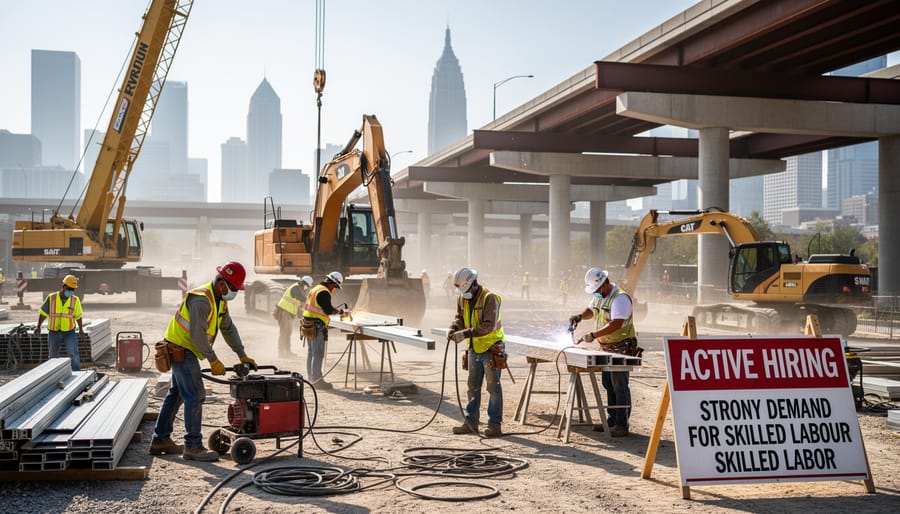
Canada’s construction sector demonstrated robust health in September 2026, with employment gains signaling sustained momentum in infrastructure and building activity. Construction added 20,400 workers nationally, representing 1.2% growth over the previous 12 months. More striking, the unemployment rate in the sector fell to 3.8%, marking its lowest level in two years and suggesting an industry operating near full capacity.
The sector’s labour force rose by 5,800 workers during the same period, a 0.3% increase that underscores worker retention and recruitment efforts amid tight conditions. This combination of employment growth outpacing labour force expansion reflects strong project pipelines and employer competition for available talent.
For Calgary, these national trends carry direct implications. The region’s broader employment surge of 59,600 jobs year-over-year positions it as a magnet for construction investment, particularly as major infrastructure projects and residential development accelerate. A sub-4% unemployment rate in construction means businesses planning expansions face immediate workforce constraints. Contractors and developers must compete aggressively for skilled trades, driving wages higher and lengthening project timelines unless labour strategies adapt.
This tightness creates opportunities for workforce development partnerships between industry, training institutions, and municipal agencies. Businesses entering Calgary’s market or scaling operations should anticipate premium labour costs and consider pre-recruiting, apprenticeship sponsorships, or modular construction methods to manage scarcity. International firms accustomed to larger talent pools will need localized recruitment tactics and relationships with regional training providers to secure crews.
The sector’s health also signals sustained business confidence. Construction employment typically leads economic cycles, and 12-month growth at 1.2% nationally indicates builders expect continued project awards. For Calgary, this aligns with commercial real estate activity and public infrastructure commitments, reinforcing the city’s attractiveness for long-term investment across sectors reliant on built environments.
3. National Employment Gains Reflect Broader Economic Recovery

Canada’s labour market showed clear signs of recovery in May 2026, providing a national backdrop that helps explain Calgary’s exceptional regional performance. The country added roughly 88,000 jobs month-over-month in May, pushing the employment rate to 60.7 per cent while the unemployment rate dropped 0.3 percentage points to 6.6 per cent. These gains signal renewed momentum across the economy, creating a more competitive environment for talent acquisition and raising questions about wage pressures and workforce availability in growth markets like Calgary.
Several national metrics contextualize Calgary’s surge:
- Unemployment fell to 6.6 per cent in May 2026, down 0.3 percentage points from the previous month
- Employment rate reached 60.7 per cent, indicating broader labour force engagement
- 88,000 net jobs were added month-over-month, the strongest monthly gain in several quarters
- Calgary economic region outpaced the national average with 5.7 per cent year-over-year employment growth
Calgary’s 5.7 per cent year-over-year employment increase stands out against this national recovery, suggesting the region is capturing a disproportionate share of new opportunities. This gap matters for businesses evaluating market entry or expansion: stronger local job growth typically correlates with rising consumer spending power and increased demand for services, though it can also tighten labour supply and elevate the cost of living 2026 pressures. Companies focused on hiring recent grads may find Calgary’s expanding job market competitive, but the region’s relative affordability compared to Toronto or Vancouver remains an advantage when negotiating offers.
For stakeholders assessing Calgary’s position, the interplay between national recovery and regional outperformance creates both opportunity and complexity. Collaborative economic development efforts that align workforce training, infrastructure investment, and business attraction can help sustain this momentum while managing upward pressure on the cost of doing business as competition for skilled workers intensifies.
Why These Trends Matter for Calgary Businesses and Workers
The 5.7% employment surge and historically tight construction labour market create tangible opportunities and pressures for businesses operating in or entering the Calgary region. For companies evaluating market expansion, the 59,600 jobs added year-over-year signal robust consumer spending power and a deepening talent pool, particularly in sectors driving growth. International businesses considering Calgary as a North American hub now face a competitive advantage: access to available workers in a region demonstrating sustained economic momentum, while national employment gains of 88,000 jobs in May 2026 alone reflect broader recovery trends that reduce market-entry risk.
However, growth brings friction. The construction sector’s 3.8% unemployment rate, the lowest in two years, illustrates acute talent competition in trades and infrastructure roles. Businesses planning capital projects or facility builds must anticipate longer hiring timelines and upward wage pressure. Companies across sectors will need to invest in talent attraction strategies, including competitive compensation packages, flexible work arrangements, and partnerships with post-secondary institutions to address skills gaps. The construction labour force’s modest 0.3% expansion over twelve months, despite strong job creation, underscores the limits of current supply and the urgency of workforce development initiatives.
For workers, these trends translate to job security, negotiating leverage, and career mobility. Skilled tradespeople, professionals in high-demand sectors, and new labour market entrants benefit from multiple opportunities and employers willing to invest in training. Yet sustaining this momentum requires collaboration. Businesses, government agencies, and community partners must align on immigration integration, skills training, and retention strategies to convert short-term gains into long-term prosperity. Companies that engage proactively with regional economic development resources position themselves to navigate talent scarcity, capitalize on growth sectors, and contribute to a resilient workforce ecosystem that benefits all stakeholders.
What to Watch: Indicators and Outlook for Calgary’s Workforce
Looking ahead, businesses and workforce stakeholders should track several critical indicators to navigate Calgary’s evolving employment landscape. Labour force participation rates deserve close attention: if participation continues rising alongside employment growth, it signals a healthy expansion; stagnant participation amid job creation may point to skills mismatches or demographic constraints limiting access to available positions.
Sector-specific hiring patterns will reveal where momentum concentrates and where it stalls. Construction’s sustained low unemployment of 3.8% suggests demand will remain strong for trades and infrastructure roles, but watch whether other sectors can compete for talent without triggering wage escalation. Speaking of wages, monitoring wage growth relative to inflation helps gauge whether compensation keeps pace with living costs and whether employers face pressure to raise pay to attract workers.
Job vacancies were 519,790 nationally in March 2025, providing a baseline for tracking whether unfilled positions continue climbing or begin to ease as labour supply expands. Immigration and population growth directly influence workforce capacity: higher net migration and interprovincial arrivals expand the talent pool, while slower growth may tighten competition for skilled workers. Policy developments at federal and provincial levels around immigration targets, skills training funding, and labour mobility can shift workforce availability and development timelines.
What sectors are driving Calgary’s job growth?
Construction has added significant employment with a 1.2% year-over-year increase and historically low unemployment, indicating strong infrastructure and development activity. The 59,600 jobs added across the Calgary economic region suggest broad-based growth, though specific sector breakdowns require monitoring current labour force data.
How does construction sector strength affect other industries?
Construction demand creates ripple effects: engineering firms, materials suppliers, equipment rental companies, and professional services all see increased activity. A tight construction labour market can also pull workers from other sectors, raising wage pressure and recruitment challenges across industries.
What workforce challenges remain?
Despite employment gains, skills gaps persist in technical trades and specialized roles. Businesses may face longer hiring timelines and increased wage competition as unemployment drops, requiring proactive talent development and retention strategies.
Where can businesses find talent development support?
Calgary Economic Development connects businesses with workforce programs, training partnerships, and government incentives to support hiring and skills development. Collaborating with post-secondary institutions and industry associations also helps access emerging talent and apprenticeship programs.
Businesses should integrate multiple data sources into planning: Statistics Canada’s monthly Labour Force Survey, provincial employment reports, and industry association updates all provide complementary perspectives. Establishing partnerships with economic development agencies and workforce planning bodies ensures early awareness of emerging trends and access to collaborative solutions for talent attraction and skills development.
Calgary’s employment momentum in 2026 reflects a resilient, growing economy that benefits businesses, workers, and community partners alike. The 5.7% year-over-year employment growth and 59,600 jobs added in the Calgary economic region demonstrate the strength of collaborative efforts between government, industry, and local organizations. Sustaining this trajectory requires continued partnership, strategic workforce development, and leveraging sector-specific opportunities in construction and beyond. Businesses seeking support or information on workforce trends and investment opportunities can connect with local economic development resources to capitalize on Calgary’s expanding market.