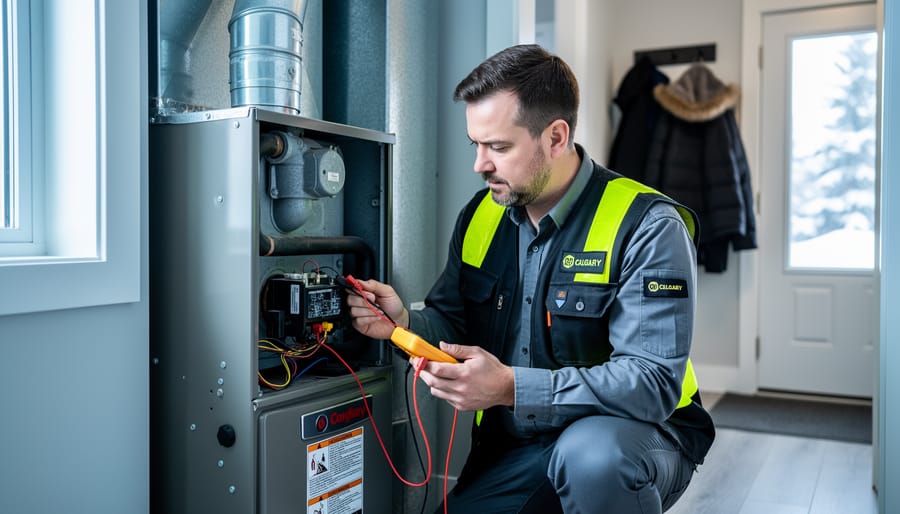
Calgary’s winter climate demands reliable heating systems, creating steady demand for qualified gas furnace repair services across the region. Homeowners and businesses depend on skilled technicians to diagnose, maintain, and restore heating equipment when temperatures drop, making this sector a practical entry point for entrepreneurs with technical aptitude and business acility.
The furnace repair industry offers opportunities for sustainable growth within Calgary’s service economy. Unlike seasonal trades or highly cyclical sectors, heating system maintenance requires year-round attention for inspections, tune-ups, and emergency repairs. Winter months naturally drive service calls, while spring and fall present opportunities for preventative maintenance contracts that stabilize revenue streams.
Starting a furnace repair business requires more than technical knowledge. Entrepreneurs must navigate mandatory licensing requirements, establish robust safety protocols, secure appropriate insurance coverage, and build customer acquisition channels in a competitive market. The regulatory framework exists to protect both technicians and customers, ensuring that anyone working with natural gas systems meets provincial competency standards.
Calgary’s economic landscape continues to diversify, with service-based businesses playing an increasing role in regional Calgary economy growth. The local market supports multiple business models, from independent operators focusing on residential service to larger companies serving commercial and industrial clients. Success depends on understanding customer expectations, maintaining technical certifications, and delivering consistent quality across every service call.
This guide provides a practical framework for launching a gas furnace repair business in Calgary. The following sections outline essential licensing steps, safety considerations, operational requirements, and verification checkpoints to help you build a compliant, profitable service company that meets genuine market demand.
Licensing and Certification Requirements for Gas Furnace Repair in Alberta
Class A vs. Class B Gas Technician Designations
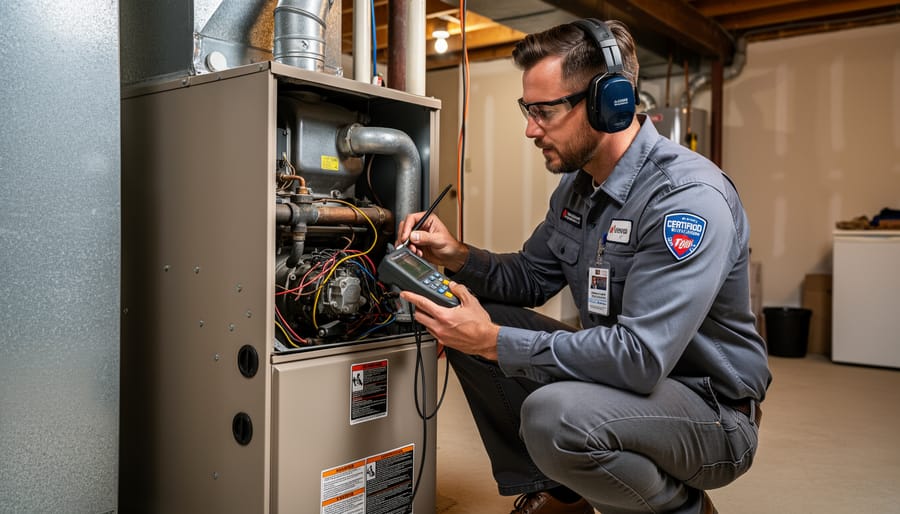
Alberta’s gas technician certification system operates on two tiers, each governing different installation and service work. A Class B Gas Technician can inspect, service, and repair existing gas appliances, including residential and commercial furnaces. This certification allows you to diagnose malfunctions, replace components like gas valves and ignitors, test combustion efficiency, and perform routine maintenance on installed heating systems. For a furnace repair business focused on service calls rather than new installations, Class B certification meets the regulatory standard.
Class A Gas Technician certification expands that scope to include installing new gas appliances and venting systems. If your business plan includes furnace replacements, system upgrades, or new construction work, you’ll need Class A certification. The training and examination requirements are more extensive, covering gas piping design, venting calculations, and installation code compliance.
Most furnace repair businesses in Calgary start with Class B certification because the service and repair market provides consistent year-round work without requiring the broader skill set and liability exposure of installation work. You can build a viable business repairing existing systems while maintaining the option to pursue Class A certification later if you decide to expand into installations. The Alberta Safety Codes Authority administers both certification levels and enforces compliance through periodic inspections.
Apprenticeship and Examination Pathway
Becoming a certified gas technician in Alberta requires a structured apprenticeship pathway overseen by Alberta Apprenticeship and Industry Training. You start by securing employment with a licensed gas contractor who sponsors your apprenticeship registration. This employer-sponsor arrangement is mandatory, you cannot register independently.
The apprenticeship demands significant hands-on experience. You’ll work under a journeyman gas fitter, logging supervised hours on residential and commercial gas systems including furnaces, boilers, and appliances. Your sponsor submits progress reports documenting your competencies across installation, maintenance, and repair tasks.
Once you accumulate the required hours and your sponsor confirms your readiness, you become eligible to write the interprovincial Gas Fitter examination. This standardized exam tests technical knowledge, safety protocols, and code compliance. The examination is administered through approved testing centres and covers both theoretical understanding and practical application scenarios.
After passing the exam, you receive your journeyman gas fitter certification, which permits you to work independently on gas systems within your certification level. For business ownership, you’ll also need to verify your credentials when applying for municipal business licenses and when securing liability insurance, insurers require proof of current certification before issuing policies for gas contracting operations.
Plan for this pathway to span several years from initial apprenticeship registration through examination completion and business launch.
Essential Tools, Equipment, and Inventory for Launch
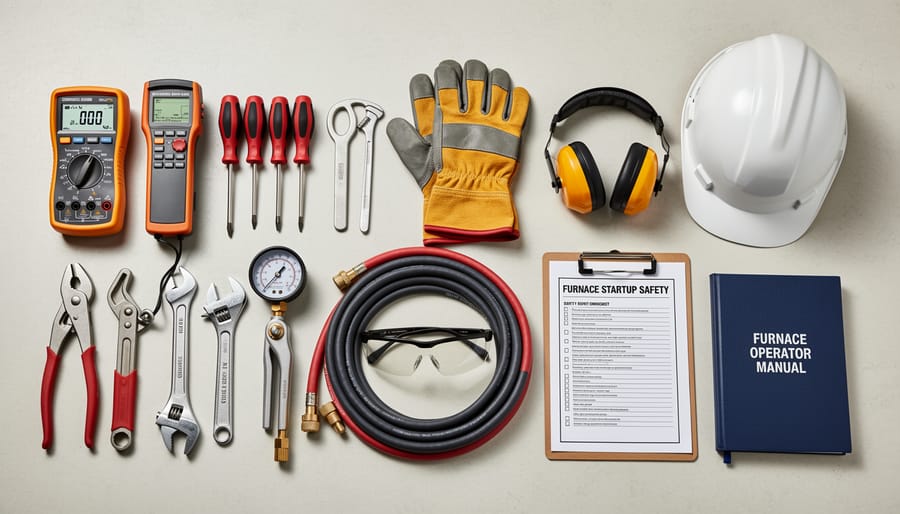
Equipping your gas furnace repair service requires a targeted investment in diagnostic equipment, hand tools, safety gear, and parts inventory that directly impacts your ability to serve customers effectively and safely.
Start with diagnostic tools, which form the technical backbone of your service capability. A digital multimeter allows you to test electrical components, thermocouples, and control boards. A combustion analyzer measures flue gas composition and efficiency, essential for verifying safe operation after repairs. You’ll need a manometer to read gas pressure at the furnace and throughout the system, ensuring proper delivery rates. An infrared thermometer helps diagnose heat exchanger issues without disassembly, while a carbon monoxide detector protects you and your customers during service calls.
Your hand tool collection should cover both mechanical and electrical work. Standard socket sets, adjustable wrenches, and screwdrivers handle most assembly tasks. Nut drivers in various sizes fit sheet metal screws common in furnace cabinets. Pipe wrenches and tubing cutters are necessary for any gas line work your certification level permits. Wire strippers, crimpers, and a voltage tester round out the electrical toolkit. Don’t overlook specialty items like a mirror on an extendable handle for inspecting hard-to-reach areas inside furnace cabinets.
Safety equipment protects you legally and physically:
- Fire-resistant work gloves rated for high-temperature components
- Safety glasses with side shields for debris protection during disassembly
- Steel-toed work boots meeting CSA standards
- Respirator or dust mask for working in dusty mechanical rooms
- Knee pads for ground-level work on basement installations
- Insulated tools for electrical work on energized systems
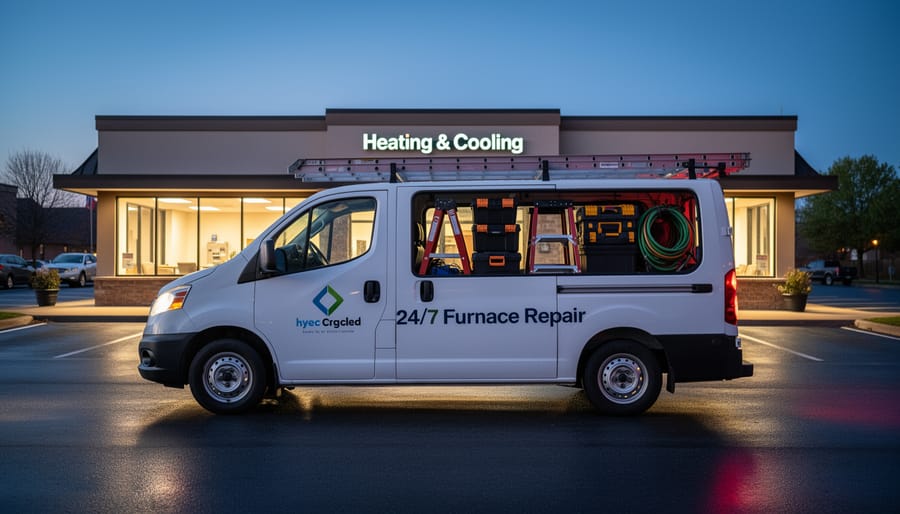
Your service vehicle needs secure storage for tools and parts. Cargo vans work well, with shelving systems that prevent equipment damage during transport and allow organized access at job sites. Vehicle signage advertising your business and contact information turns every service call into a marketing opportunity throughout Calgary neighborhoods.
Initial parts inventory lets you complete common repairs without delays. Stock frequently replaced items like ignitors, flame sensors, air filters in common sizes, capacitors, and thermocouples. Keep assorted fuses, wire connectors, and sheet metal screws on hand. Relationships with local HVAC supply houses let you source less common parts quickly when needed, but having basics in inventory distinguishes professional service from hobbyist attempts.
Investment in equipment and inventory varies based on whether you’re buying new or used tools and how much parts stock you carry initially. Plan your purchases around the work your certification permits and the specific furnace brands most common in your target service area.
Insurance, Bonding, and Liability Protection
Operating a gas furnace repair business in Alberta exposes you to significant liability, making comprehensive insurance coverage non-negotiable. Before you accept your first service call, verify that every required policy is active and adequate for the risks inherent in working with natural gas systems.
General liability insurance is foundational. It covers third-party claims for property damage or bodily injury that occur during your work, think a client’s water heater damaged while you access a furnace, or a customer injured by tools left in a walkway. Policies typically provide coverage for legal defense costs and settlements, protecting your personal and business assets from claims that arise from routine service operations.
Professional liability, also called errors and omissions insurance, protects against claims stemming from your technical work. If a furnace you repaired malfunctions and causes property damage, or if a misdiagnosis leads to additional repair costs, this coverage responds to allegations of negligence or faulty workmanship. For gas technicians, whose errors can result in carbon monoxide incidents or gas leaks, this protection is essential during budget planning for your launch.
If you hire employees or subcontractors, Workers’ Compensation Board coverage becomes mandatory in Alberta. WCB provides wage replacement and medical benefits if a worker is injured on the job, and enrollment protects you from direct lawsuits by injured employees. Rates are based on your industry classification and payroll; confirm your coverage is current before anyone works under your direction.
Bonding, though not always required for residential work, demonstrates financial credibility when bidding commercial contracts or working with property management companies. A surety bond guarantees that you’ll complete contracted work or compensate the client if you default, offering them recourse beyond your insurance policies.
Finally, ensure your service vehicle insurance includes commercial use coverage and tools-in-transit protection. Standard personal auto policies exclude business activities, leaving you unprotected during service calls if you haven’t upgraded to a commercial policy.
Step-by-Step Process to Register and Launch Your Business
Choosing Your Business Structure
Your business structure determines how much liability protection you have and how the Canada Revenue Agency taxes your income. Each option carries different trade-offs for a gas furnace repair operation in Alberta.
A sole proprietorship is the simplest path, you operate under your own name or a registered trade name, and all profits flow directly to your personal tax return. You’re personally liable for any claims or debts, meaning your personal assets are at risk if a furnace repair goes wrong or a customer sues. Many new technicians start this way because setup is fast and inexpensive.
A partnership splits ownership and liability between two or more people. Each partner reports their share of income on their personal return, and all partners are typically jointly liable for business obligations. This structure works if you’re launching with another certified technician or sharing startup costs, but requires a clear partnership agreement defining roles, profit splits, and exit terms.
Incorporation creates a separate legal entity. You become an employee or shareholder of your own corporation, which shields your personal assets from most business liabilities. Corporate tax rates in Alberta can be lower than personal rates on the first portion of income, and you gain flexibility in how you pay yourself, salary, dividends, or a mix. The trade-off is higher accounting costs and more paperwork. For HVAC work carrying significant liability exposure, incorporation often makes sense once you’re past the startup phase or hiring employees.
Consult an accountant familiar with Alberta trades businesses before deciding; the right structure depends on your revenue projections, risk tolerance, and growth plans.
Establishing Supplier and Vendor Relationships
Reliable parts access determines whether you can complete most service calls the same day or leave customers without heat while waiting for shipments. Start by contacting major HVAC distributors serving Calgary, most require a business license and proof of gas technician certification before opening a trade account. Visit local branches to establish face-to-face relationships with counter staff and sales representatives who can expedite orders when you need urgent parts. Negotiate payment terms that balance cash flow with creditworthiness; many distributors offer net-30 terms once you’ve established a payment history. Stock commonly replaced components based on the furnace brands prevalent in Calgary homes, but avoid tying up capital in slow-moving specialty parts you can order as needed. Develop backup supplier relationships so a single distributor’s stock-out doesn’t strand you mid-repair.
Marketing Your Gas Furnace Repair Services in Calgary
Building a customer base in Calgary’s competitive heating service market requires a focused, multi-channel approach that aligns with how homeowners and commercial property managers search for and select contractors. Your marketing strategy should balance digital visibility with relationship-based tactics that establish trust before an emergency furnace breakdown forces a rushed decision.
Start with local SEO fundamentals. Claim and fully optimize your Google Business Profile with accurate service areas, operating hours, certification credentials, and a steady flow of customer reviews. Calgary homeowners searching for furnace repair typically include neighborhood names or postal code prefixes in their queries, so ensure your profile and website content reflect the specific communities you serve. Schema markup on your website identifying you as an HVAC contractor and listing your service area helps search engines connect your business to relevant local queries.
Effective marketing channels for Calgary’s heating service market include:
- Google Local Services Ads for verified contractors appearing above organic search results
- Partnerships with real estate agents and home inspectors who refer new homeowners needing system evaluations
- Home warranty provider networks that dispatch repair calls to approved contractors
- Property management company service agreements for multi-unit residential buildings
- Seasonal direct mail campaigns targeting neighborhoods with older housing stock
Time your marketing investment to Calgary’s heating cycle. The September-to-November period, when homeowners prepare for winter, generates the highest search volume for furnace maintenance and pre-season inspections. Late January through March brings emergency repair demand when aging systems fail during sustained cold. Advertising spend during these windows typically delivers better customer acquisition costs than summer months.
Build relationships through local partnerships with complementary service providers. Property management companies managing hundreds of rental units need reliable contractors on call. Home warranty companies require a vetted network of technicians. These relationships provide steady call volume that stabilizes revenue between peak seasons, and the Calgary Regional Partnership’s business development network offers structured opportunities to connect with potential commercial clients and referral sources across the region.
Verification: Confirming You’re Ready to Operate
Before you schedule your first service call, confirm that every compliance and operational requirement is in place. A systematic verification process protects you from liability exposure, regulatory penalties, and the reputational damage of operating prematurely.
Start by verifying your Gas Technician certification is current and on file with Technical Safety BC. Request a written confirmation letter or access your online portal to download proof of certification. Keep a physical copy in your service vehicle and a digital backup accessible on your phone, as customers and building managers may request verification before granting access to mechanical rooms.
Confirm your insurance policies are active and paid. Contact each carrier, general liability, professional liability, and vehicle insurance, to request certificates of insurance showing current coverage dates. Verify your WCB account is in good standing if you have employees, and obtain your clearance letter. Many commercial clients and property management companies require proof of insurance before authorizing work, so keep current certificates readily available.
Check that your business registration is complete with Alberta Corporate Registry and your GST number is active if applicable. Confirm your municipal business license is issued and displayed properly. These foundational registrations affect your ability to invoice, open trade accounts, and operate legally within Calgary’s jurisdiction.
Inspect your safety equipment systematically. Test your combustion analyzer calibration, verify your carbon monoxide detector batteries, and confirm your fire extinguisher is charged and current. Replace any expired first aid supplies and ensure your personal protective equipment meets current standards.
Finally, conduct a practice service call with a colleague or mentor observing. Walk through your diagnostic process, tool organization, customer communication approach, and documentation procedures. This dry-run reveals workflow gaps and builds confidence before real customers depend on your service. The cost of doing business in Calgary rewards thorough preparation, operators who verify readiness avoid costly delays and build reputations for professionalism from day one.
Common Questions About Starting a Furnace Repair Business in Calgary
How long does it take to launch a gas furnace repair business from initial decision to serving your first customer? The timeline varies based on your certification status. If you already hold Gas Technician credentials, you can complete business registration, insurance setup, and supplier arrangements within four to eight weeks. Starting without certification requires completing an apprenticeship program first, which typically spans several years of supervised work alongside classroom instruction and examinations.
What are the typical startup costs for a furnace repair business in Calgary?
Initial investment covers certification fees, tools and diagnostic equipment, insurance premiums, business registration, a service vehicle, and initial parts inventory. Expect substantial capital requirements that vary based on whether you start solo or hire technicians immediately.
Should I specialize in furnace repair only or offer broader HVAC services?
Specializing in gas furnace work allows you to build deep expertise and streamline your inventory, while broader HVAC services increase your addressable market year-round. Many operators start focused and expand as they establish customer relationships and cash flow.
How does Calgary’s seasonal demand affect business planning?
Calgary’s extended heating season drives peak service calls from October through March, with emergency repairs concentrated during cold snaps. Successful operators plan cash flow for seasonal fluctuations and consider maintenance contracts to smooth revenue throughout slower summer months.
What growth pathways exist for scaling a furnace repair business?
Common expansion routes include hiring additional certified technicians, adding installation services alongside repair work, developing commercial contracts with property managers, and building maintenance agreement programs. Maintaining workforce health and safety standards becomes critical as you grow your team.
Can you operate part-time while building your customer base? Yes, provided your certification and insurance remain current, many technicians launch alongside employment elsewhere. This approach reduces financial pressure during the startup phase while you establish reputation through referrals and repeat business. Full-time commitment becomes necessary once service volume demands consistent availability and you begin hiring staff.
Starting a gas furnace repair business in Calgary requires commitment to proper certification, safety protocols, and regulatory compliance. The regional market offers consistent demand driven by Calgary’s cold climate and extensive residential base, but success depends on meeting Alberta’s strict Gas Technician licensing standards and maintaining comprehensive liability coverage. Cutting corners on certification or insurance creates unacceptable risk for both your customers and your business viability.
Local entrepreneurs benefit from Calgary’s established business infrastructure and networking opportunities. The Calgary Regional Partnership provides resources for new ventures, including connections to suppliers, industry associations, and business development support tailored to regional economic growth. Building relationships within the local HVAC community and leveraging these partnership networks helps establish credibility and access to ongoing technical education.
Before launching your service, verify every legal requirement is satisfied: certification active, insurance policies in force, business registration complete, and safety equipment inspected. Calgary’s heating market rewards contractors who demonstrate expertise and professionalism. Approach this business with thorough preparation, ongoing skills development, and a commitment to customer safety, and you’ll position yourself for sustainable growth in a market where quality service consistently finds demand.